Sunday, September 22, 2013

The Forward Population of Palencia

Castille and Leon is the largest autonomous community in Spain in terms of geographic space. Land-locked, it is a dry region with hot summers and freezing winters. Rain, snow, and wind are rare occurrences in the local weather. Despite being such an enormous province, the population per square acre is very small.
Palencia is a small city, located nearly equal distances from Burgos and Valladolid, two other cities of the region.
I have been assigned to an elementary school on the southern side of the city as an English language assistant. I'll talk more about this job in another post. For now, we'll talk about the city.
 La Calle Mayor (Main Street) is filled with enchanting old buildings, with a shaded passage supported by pillars, to protect shoppers from the hot sun during the afternoon. In some places, through art and architecture, the old meets the new with traditional buildings and contemporary art.


  It is a beautiful place with a lot of gardens that are full of trees and grass, despite the low humidity.
A coworker told me that they say the people of Castille and Leon are like the weather here. They can be warm to you, or cold to you, but they will most certainly be dry. I am not sure yet how true that is, but in general I do not have issues with living among serious, dry, people. Thus far I have not found anyone particularly cold.

The Spanish in general are a very friendly people. They are open and good listeners, despite being VERY good talkers. And shouters. They are also good lookers. Not necessarily in the sense that they are pleasing to the eye (they are not displeasing, however they certainly don't look Hollywood), but certainly in the sense that they like to look. Spanish men, especially those of older generations, stare. Passing glances for a Spaniard feel like a long, awkward moment of checking-out a stranger to Americans. There is also a serious lack of personal space and boundaries, as compared to what an American is used to. Greetings and conversations with strangers and acquaintances are more intimate than those I have with my closest friends and family back home. My first day at the school, upon meeting one of the teachers, I was grabbed by the hand and pulled along like a child as she showed me around the school. Although it is just briefly on either cheek, I am kissed by more people in one day in Spain than in an entire year in the US.

Later in the week, I went to the train station but arrived too early, and found myself sitting and enjoying a park nearby. I sat down on a bench to read and was approached by an older gentleman who asked if I was passing the time by myself. I told him I was waiting on my train, and he said that I should wait for him on the bench, and he'd find out exactly when my train would leave. He came back to tell me I had an hour to wait. Then elected to sit beside me and tell me all kinds of things. I cannot say that Palencians are unkind in anyway, but they are more forward, perhaps, than other Spaniards that I know. He spent the better part of our talk flirting with me. He caressed my arm and recited a poem, and then confessed his undying love for me. Something that would paint him an audacious and disgusting old man in the US. In Spain, they might call him a 'viejo verde' or 'old green guy.' In all seriousness, I now feel the need to avoid the park side of the train station just to avoid him. Rana of course says that it is a simple fact of life in Spain, and I either need to get used to it, or be bold enough to tell off creepy old men.

Although it is a charming city, Palencia is not meant for heavy tourism. It would not be advisable for a tourist to go out of their way to stop in Palencia. But if one was taking a trip through the region, and needed a place to stop and stretch their legs, it is a good place for taking walks or having a refreshing drink. It has all of the basic living essentials, and even sports a bowling alley (a true rarity in Spain, and something I missed dearly last year).

I'm looking forward to sharing more experiences and photos with you all.

Tuesday, September 3, 2013

A New School Year, a New Adventure

I am very excited to announce that I will be returning to Spain in just ONE WEEK to be an assistant English teacher in a bilingual grade school!

The city I have been placed in is Palencia, a pleasant, land-locked, regional capital, near the top of the autonomous region of Castilla y Leon. Expect updates throughout the coming year as I explore the small city, surrounding areas, and beyond!
 
In the mean time, this coming week I am doing a road trip through Oregon, California, and Nevada with my parents and younger brother. It is essential to be aware that a global perspective includes one's own country and even one's own family. This will be my first trip to Nevada and I am looking forward to observing the regional differences between the three states as we make our way through.

There are so many wonders to see and think about.

Monday, January 28, 2013

Reverse Culture Shock

This odd turn of phrase is something you are told about over and over before going and before returning from a study abroad. I have been home for over one month now, and am not sure that I can say I've truly experienced it yet.

I would argue that culture shock itself is no that different from any social or life transition that we make. Your first day of school as a small child is, at the time, an enormous transition and causes many emotional upheavals. The same thing happens when we first move away from home, when a family member or friend passes away, or when we go on our first date. Clearly some transitions are more uprooting than others, but they all have a similar element.

What makes returning after being away so long so different is that all of those people that would have normally been a part of your transitions, have not been there. Things have not only changed dramatically for you, but also for everyone who once made up your previously much smaller world. The struggles you face are attempting to talk to a friend who you once could talk for hours with, and finding you have very little to say at all. Awkwardly you try to answer their questions about your adventures abroad, but find it is like telling your friend about a painting that you've seen. You can describe all that you want, but no one will ever understand the depth and wealth of Las Meninas without actually standing in the Prado and staring straight at it. So you describe and explain, and they smile and pretend to understand. Then you ask about their adventures over the year, and they cannot find anything to tell you. Although more than 365 days have gifted them with new knowledge, new experiences, new joys, and perhaps new sorrows, they can't find anything they want to tell you. I cannot see that in the span of one year so much could have changed for me, and so little for my friends.

For me, my transitions have been new almost once every four months. From January to April of 2012, I experienced Barcelona and being on my own for the first time. I spent time with a cluster of other students. I learned what it was like to go out to bars with other college students, how much fun it can be to dance at clubs, and how quickly a friendship can be forged with total strangers when you feel isolated.

From May until August I learned a whole other social aspect that perhaps I deprived myself from up to that point. For the first time in my life I let romance be a leading point for me. I also learned to swim fearlessly in the ocean, what it means to teach, and how much I could love British baked goods.

September until December was a time of struggle in a whole new way. I forced myself to speak in another language nearly ninety percent of the time. I discovered that helping someone else feel good was the fastest way to make myself feel good, that losing a pet hurts just as much if you haven't seen them in nine months as if you were holding them as they died.

In all, a year abroad is a year to grow, to learn, to experience and explore, to mourn, and to make friends.

Now that I am back on the other side, I already am making plans to leave again.
Perhaps that is the way in which reverse culture shock is effecting me. I do not feel a dislike for my own home, but I feel a strange homesickness for Spain and Europe.

Wednesday, November 14, 2012

Castellers: Catalan Trust

The Catalan culture is stereotyped in Spain as being a stingy, over-thinking, selfish one. But the truth is, they are frugal, logical, trusting people. Nothing shows the Catalan trust like the team sport of Castellers. My host sister, M, asked me to accompany her to her practice last night. It was my second time going, and my first time going somewhere alone with the bright-eyed seven year old.
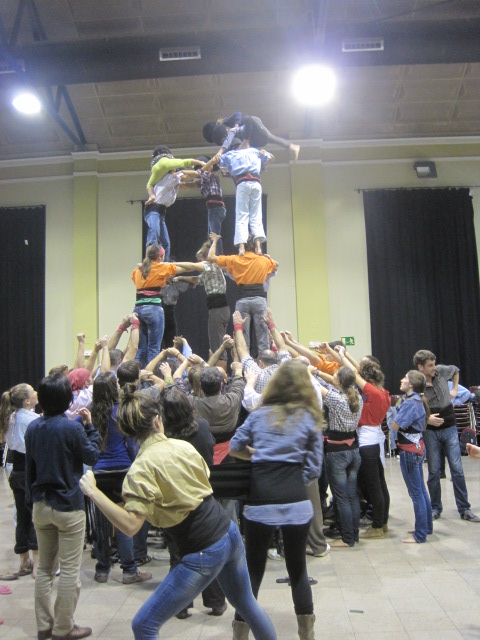
 Castellers is the building of human 'castles' and is seen throughout Catalonia during big festivals and events specifically for the Casteller competition. The castles are built up of people ranging in age and height, and always include adults, children, men, women, boys, and girls. Dozens of them.
 The 'uniform' for Castellers is a long bandanna wrapped around the waist, and a high collared shirt. The collar of the shirt is worn up right, to protect the neck from those climbing your back. The bandanna serves as a step for the shorter climbers when making their way up the tower.

 Now when we talk about trust, we see here a young man holding up M by just her ankles. Similarly, I felt the trust of her mother, E, as she let me take her daughter to the practice. It is a big responsibility to be trusted with someone else's child, especially when the child is spending an hour standing on people's shoulders and climbing up and down like a monkey.

 There are different styles of castles that they build. They can be as few as this, with three people in one tower....
Or dozens in towers made up of as many as six layers with five or more people on each layer. The names for the different types of castles are given in the numbers in Catalan of how many layers there are and how many people are in each layer. The castle is almost always topped with a small child who crawls over the top, and then slides back down into the base. Most of the people at the base serve as catchers in case someone falls.
 I hope you enjoyed the video and that some day you get the chance to view one in real life. It is simply spectacular what people can accomplish when they work together.

Sunday, September 30, 2012

What Sorcery is This?

I am aware that I have a way of doing things that is unconventional. My study abroad experience is of course no different. I have elected to do a full calendar year abroad rather than an academic year, as you may be aware from reading my blog. It is gloriously entertaining to watch the faces of people at the university recognize me from this winter, scratching their heads and asking "Estuviste aqui antes, no?" "You were here before, weren't you?" I am certain that my situation is new for my program, and is probably new for the university I attend. Already I have encountered some kind of hick-up in the university email system related to my situation.

Another amusing reaction I receive is how impressed my previous acquaintances are with the level of Spanish I have reached in such a short amount of time. Thinking about it, I have been studying the language since last June, more or less. I took eight weeks of intensive Spanish over the summer in 2011. That fall semester I took the first term of second year Spanish. At the end of which I could confidently introduce myself and ask for the bathroom, but could not hold any form of spontaneous conversations. My first semester in Barcelona saw some improvement, but not as much as I had hoped four months would bring. The real turning point, I discovered, was the second time I enrolled in intensive courses. I spent one month with a handful of others speaking and practicing Spanish four hours a day, five days per week. At the same time I was meeting about twice per week with a Peruvian woman for language exchange. By the beginning of July I was talking politics and far above a B1 level in Spanish.

At this moment I feel the need to explain that in Europe, your linguistic level is measured on a six level scale. A1-C2. With A1 being someone who knows next to nothing, and C2 being an educated fluent speaker. A B1 is someone who can have basic conversations and convey ideas, but only on limited subjects and in simple sentence structures. C1 would be generally considered fluent with no higher education. For a fuller description, pop over to wikipedia and search for ways to measure language ability. They also have the American scale to compare with.

 I took the month of July off from classes, for my trips to London and the village, but continued daily practice with my brother in law, O, his family, and the local college students with whom I went out on weekends. Especially with one specific young man. The second half of August and the first week of September I spent in more intensive classes, where they placed me as a high B2 or low C1 (the group was small and we were quite mixed).
Now, back in Barcelona, I am enrolled in five classes taught entirely in Spanish and speak daily with my host family in the language.

When it all comes down to it, there are three important steps, I believe, to learning a language.
1. Get a practical base: That is, take a class that teaches fundamentals and a good deal of vocabulary.
2. Talk with someone: Once you can understand the basics, build the complexity by talking, if possible, on a daily basis with a native speaker. If you are too shy to talk much, find someone who likes to talk. It will be good for you to just listen, sometimes.
3. Use it in daily life: Listen to music in your new language. Watch movies, talk to friends, and read the news. Immersion is the fastest way to learn. And that means using the new language as if it was your first.

I believe that with full immersion the average person could reach a B2 level in around six months. That would be 20 hours a week of intensive course work (with 10 to 15 hours of practical homework outside of the class), four hours of conversation with a talkative native speaker, and an additional 5 to 10 hours of media or "fun," listening, watching, and reading. In short: 39-49 hours per week of the language you are trying to learn. (Or 936-1176 hours total.)  Obviously most people cannot give up that kind of time all at once. But this is my theory on learning a language quickly. Like anything else worth doing, it takes time, effort, and a will to succeed.

Tuesday, September 11, 2012

Back to Barcelona!

It was a bitter sweet goodbye as I left the Santander airport for the one in Barcelona. The summer went by so quickly, I hardly noticed how much my Spanish had improved, or how fond I had grown of the people there. Especially of one person in particular. It seems traveling women in my family are fated to meet someone special on our journeys. But romance is not a topic I intend to attend to here.

I was apprehensive as I got off of the plane, not sure if things would be alright, if coming back for the fall semester was what would be best for me. But the second I was on the street of my host family's apartment, I felt a sort of relief. I knew I was where I belonged. A hug from my host sister told me that they thought so too.

Of course, back home, September 11 marks a devastating day in our recent history. It is one of the few moments in recent history that everyone in the USA felt truly united. But here in Barcelona, September 11 is celebrated as the day of Catalonia. It represents their want to be severed from Spain.
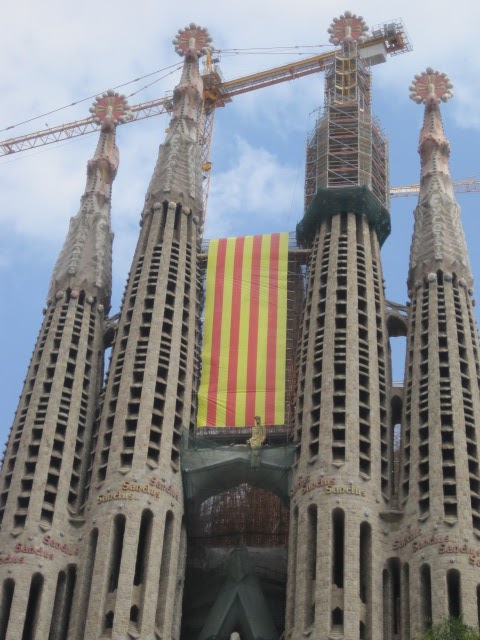
 The Catalonian flag is a golden background with four red stripes. The Catalonian flag for independence includes a blue triangle with a five pointed star. Today I watched dozens of people carrying or wearing this mark of independence.
Buildings were strewn with either of the two pertinent flags. I suppose using the standard Catalonian flag signifies that you are neutral and flying the other shows your support of separation. Personally, although my feelings do not matter at all in this question of nationalism, I think that wanting an individual government is a sign of regression. The world improves when we are united.
People should be free to speak the languages and practice the religions they choose, and should not feel the need to seek out rivals or enemies. There should be no "them against us" situations. Just "us" against whatever mother nature throws our way. I believe cultural heritage and pride in that heritage are important. Especially if we are to keep open minds. But we must not be so prideful that we stifle the chance at unity, the chance for harmony. I take pride in acknowledging that I am a member of the human race. I hope someday everyone will be able to put first that they are human, and second that they are of a specific nation.

Saturday, August 11, 2012

Summer Festivals

It is a ridiculous statement to say that there is a 'party season' in Spain. The Spanish are all about everything that defines parties. They love to get together in big groups, drink, eat, dance, and have the best time of their lives. There are festivals, holidays, and celebrations that take place all over Spain throughout the year. But the summer months are the most concentrated form of this. With all of the youth free and in the streets, what better way to keep them entertained than to give them something to celebrate? I would argue that the theory here is that happy children have no reason to cause problems.
It is fair to say that this concentrated part of the year begins in June on with San Juan (Saint John) day, a national celebration to signify an end and a beginning. It is much like how we treat New Years in the US. It is a celebration to get rid of the old and bring on the new. Students, whose school-year has ended, burn notes or tests to show they are done with the year. Some people burn a list of things they want to change in their lives or something they want to forget. In Santander the entire city and the surrounding villages go to the beach where they start bonfires, drink in excess, and bathe in the ocean throughout the night.
Following this nation-wide celebration, the first of the localized festivals begin. Every city, town, village, and settlement has its own unique celebration. Generally it is related to a Patron Saint or significant event of the location.
The celebrations, or Ferias (fares), generally consist of street music, food, and drink, as well as a local custom. One of the more well known festivals is that of the tomato fight near Valencia, which takes place every August, and consists of an entire town throwing old tomatoes at one another. Most festivals last several days, and contain set events for each day, tending to end the festival with the most peculiar of them.

In Tarilonte, the darling village in which my O's grandparents live, the festival is a three day celebration. The first day consists of an honorary lunch for the elders of the tiny town (they hold a winter population of thirty), and large family dinners in individual houses. The second day is the Patron Saint's day, and is centered around attending church, carrying a statue of the Virgin Mary, and ringing the church bells manually. Then musicians set up at night to bring excitement and dancing to the street as everyone dances their shoes off. The third day is the most interesting, and would remind most Americans of Halloween. The events of the day go as follows: everyone dresses in their worst clothes, or cheap costumes, and head to a particular house. Along with the crowd is a walking band that plays exciting music.
  The first house has snacks and drinks. Everyone takes a beer, a cup of soda, or some sangria, and a handful of snacks. Once the first house is exhausted, the horde of perhaps two hundred (children, adults, everyone but the eldest members of the community and the heads of house of each house) moves on to another house where the consumption continues. This goes on, and by the third or fourth house, someone will have started spraying someone else with water, or with sangria.
 By the end of the walk, most people are soaked, drunk, and dancing and laughing like they've never done so before. The party reaches their final destination at around six PM after beginning at around noon. They reconvene in the town square where the band stage is set up and begins playing again once it becomes dark. New comers to the festival, and anyone who is particularly peculiar, will be dragged at some point during the events of the day to the fountain, where they are either forced under or must submerge of their own free will. 

Similar festivals are played out in every village on some weekend between June and September. In Santander, it is a two week event that includes street-vendors who sell cheap bite sized snacks with drinks, have fare-rides, and a circus or other similar entertainment.

If you are looking for a time of year to party your way through Spain (which is not at all a hard thing to do) I suggest the summertime. You are guaranteed to find something going on in every region you visit, no matter what days or weeks you have the chance to be here for. I would suggest if you're coming in July or August, that you travel for the Northern regions, because the central and South of Spain are quite warm throughout the summer (reaching triple digits in Fahrenheit almost constantly) while regions like Cantabria, Galicia, and the Basque country are cooler and have rainy spells for all of the Atlantic currents.